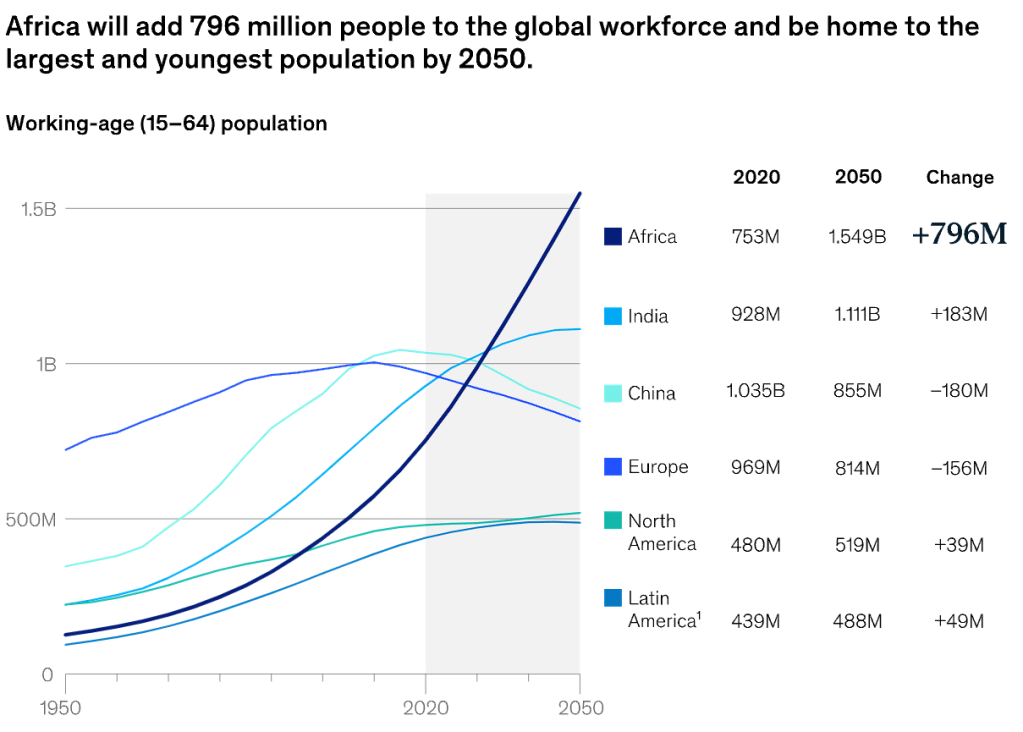
Africa will soon have the world’s largest working age population and a flourishing consumer class; it is also rich in natural resources such as oil, natural gas and minerals. However, the continent’s economy slowed over the past decade from an average GDP growth rate of 5.1% annually from 2000-2010 to just an average GDP growth rate of 3.3% a year. However, there are many African countries that exceed this growth rate, largely in East and West Africa (weforum, 2023).

African economies are shifting from agriculture to services but productivity is still lacking. The real productivity of Africa’s services sector, at $7,200 in 2019 compared to $8,900 in India, $17,700 in Latin America, and $20,900 in China, is the lowest of any region in the world. Improving productivity across the continent would allow the services sector to create at least 85 million new jobs by 2030. The number of new services jobs would almost triple if Africa matched the productivity of Asia’s strongest services hub, which would add $1.4 trillion to the continent’s economy (McKinsey, 2023).
The real problem is that the continent of Africa does not view itself as a single nation and neither should it, as it is home to 54 culturally and linguistically diverse countries. However, this is beginning to affect every nation’s willingness to trade and is hindering the entire continent’s economic growth. Africa trades much more with economies beyond the continent than within. Only 10 percent of its imports and 17 percent of its exports are intraregional. By contrast, in the Association of Southeast Asian Nations, or ASEAN, 21 percent of imports and 22 percent of exports are intraregional. To combat this, African public and private sector leaders should find ways to maximise the potential of the African Continental Free Trade Agreement, which aims to reduce border constraints between nations and improve the flow of technology and human talent across borders.
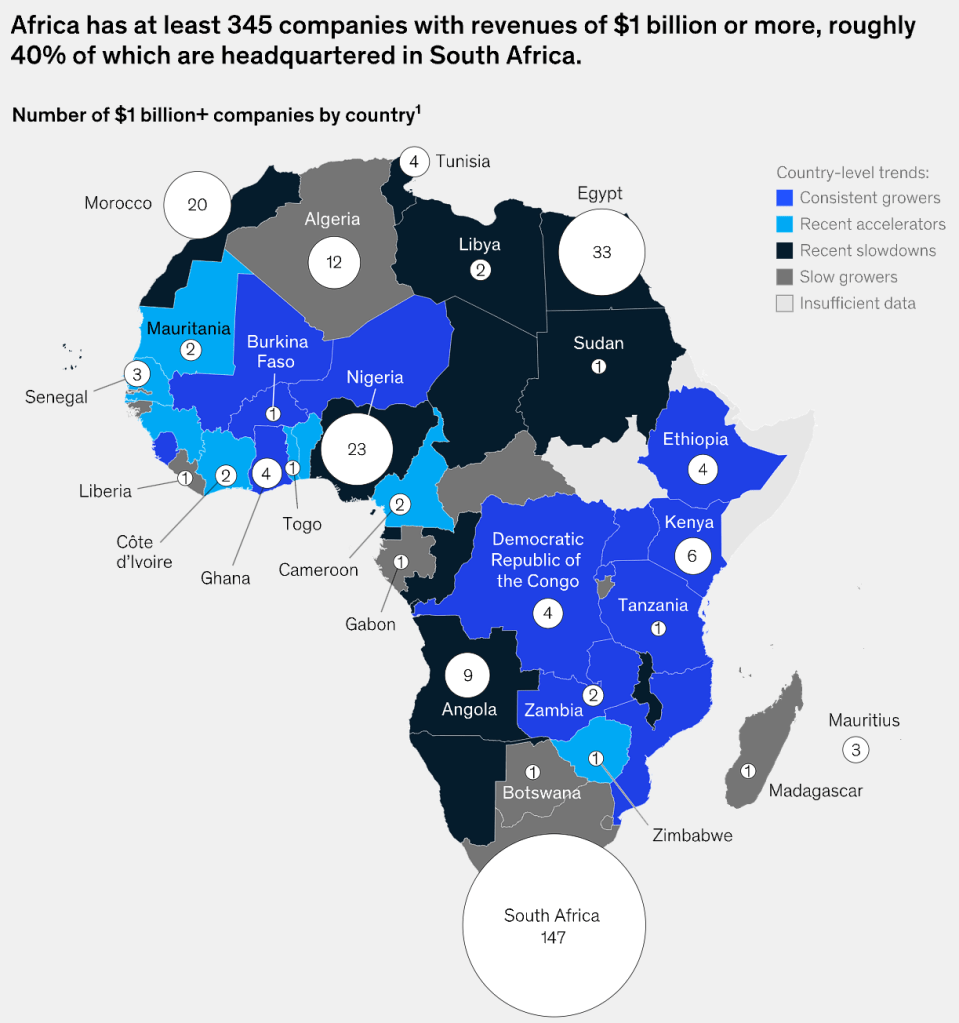
Africa also has many large companies that contribute massively towards growth, innovation, employment and exports. In Africa today, at least 345 companies have annual revenues of $1 billion or more. Collectively, they produce revenues of more than $1 trillion. Mckinsey estimates that large companies in Africa could increase their revenues collectively by more than $550 billion by 2030, hugely boosting the continent’s economy.
Finally, Africa has potential to unlock more than $3 trillion in consumer spending, however, consumption in Africa is hindered by widespread poverty across the continent; roughly a third of the total population (430 million people) lives in extreme poverty. However, it is estimated that by 2030, over 250 million Africans are expected to join the consuming class, unlocking the $3 trillion in consumer spending, whilst creating an opportunity for businesses to offer affordable prices at scale, target expansion in growth hot spots, and innovate in local value chains.
References:
Mayowa Kuyoro, & White, O. (2023, September 28). How Africa can turn diversity into growth and opportunity. World Economic Forum. https://www.weforum.org/agenda/2023/09/africa-economy-diversity-growth-opportunity/
Reimagining economic growth in Africa | McKinsey. (n.d.). http://Www.mckinsey.com. https://www.mckinsey.com/mgi/our-research/reimagining-economic-growth-in-africa-turning-diversity-into-opportunity
 Project Frafrica
Leave a comment